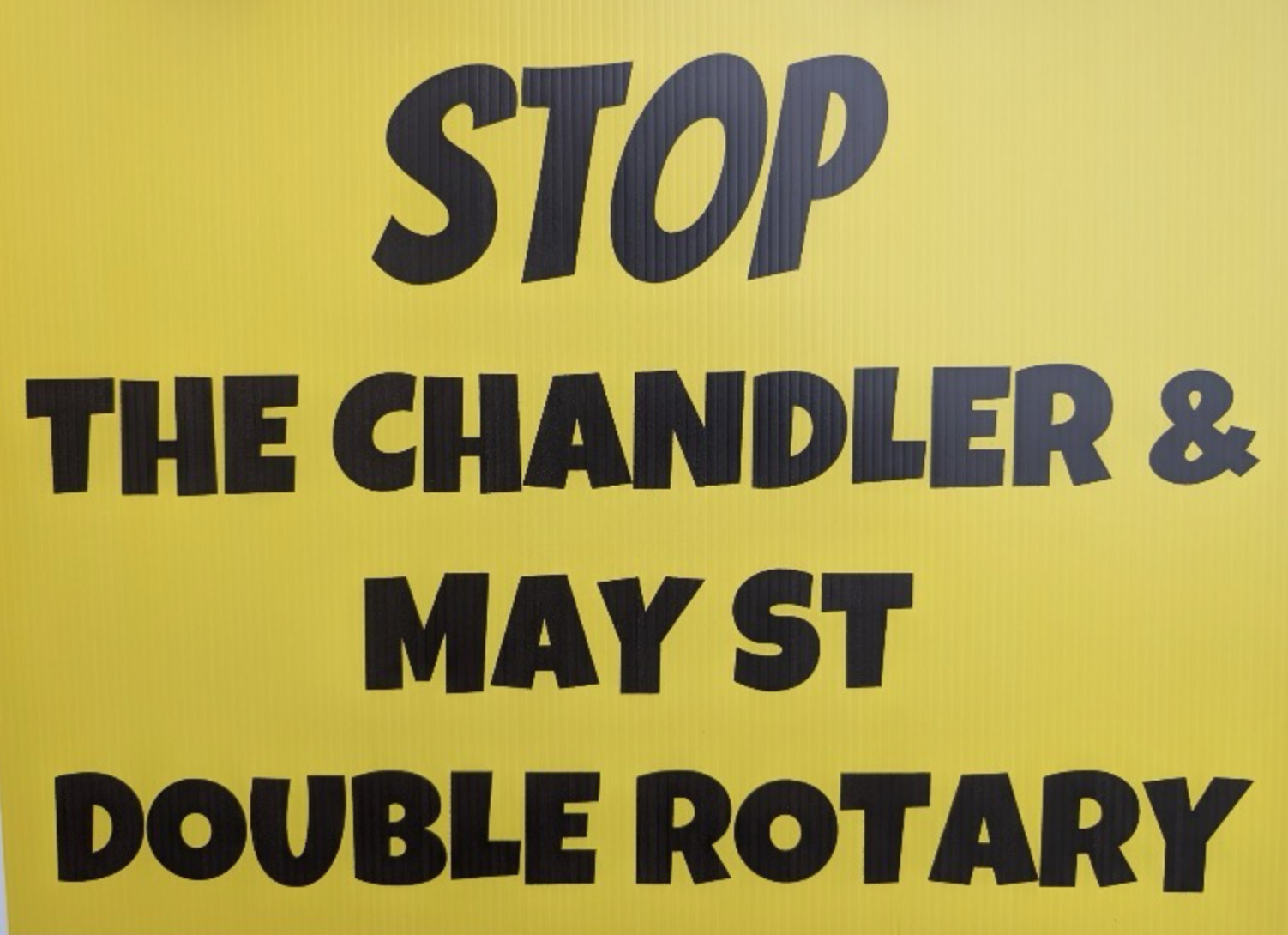
The Facts
The city says the Chandler Street double roundabout will improve safety and traffic flow. Here is what the data, the research, and the project details actually show.
What This Project Costs Your Community
Your homes:
At least three properties have received notifications from the city informing them that their land is being taken by eminent domain to make room for this project.
Your tax dollars:
The project is budgeted at $8.5 million in federal TIP funding, but that does not cover everything. A large aqueduct runs underneath Chandler Street and would need to be lowered to make room for the roundabouts, and that cost is not included in the $8.5 million — it would come directly out of city tax dollars. On a project of this size, additional cost overruns are likely.
Your daily life:
City Manager Batista stated the project will take at least 3 years to complete, and Worcester State University estimates closer to 4. During that time, construction will disrupt traffic for city drivers, surrounding neighborhoods, and local businesses. May Street School and the Worcester Dual Language Magnet School are both in the immediate area, along with thousands of WSU students, faculty, and employees who use these roads daily.
Roundabouts Are Worse for Pedestrians
It is well established that roundabouts reduce the severity of car-to-car crashes. However, the claim that they are also safer for pedestrians is not supported by the research, particularly in areas with high foot traffic near schools, retirement facilities, and neighborhoods with children, elderly residents, and people with disabilities.
Key findings from peer-reviewed research:
- Cars in roundabouts rarely come to a full stop, and drivers are focused on merging with traffic rather than watching for people crossing the street. (Elvik, 2017; Gruden et al., 2021)
- The more pedestrians there are, the less safe roundabouts become. Safety results drop as foot traffic increases. (Alozi and Hussein, 2022)
- There are no walk signals at roundabouts. Pedestrians have to judge gaps in moving traffic and cross when they think it is safe.
- Roundabouts are especially dangerous for children, elderly residents, and people with disabilities or mobility aids. Federal guidelines do not currently address how to make roundabouts accessible. (FHWA)
- After Minnesota converted intersections to roundabouts, pedestrian crashes increased 70%. At dual-lane roundabouts, pedestrian crashes increased 500%. (MnDOT Roundabout Study)
- Studies have found that many pedestrians simply avoid roundabouts because they feel unsafe, which means crash statistics undercount the actual risk. (Gruden et al., 2022)
The proposed Chandler Street location sits between two elementary schools, a university with thousands of daily pedestrians, residential neighborhoods, a Little League field, and two retirement facilities. This is exactly the type of high-pedestrian-volume location where roundabout research shows the greatest safety risk.
Read more: “Are Roundabouts Safer for Pedestrians?” — an in-depth analysis of the research →
How Dangerous Are These Intersections? The Data Tells the Story.
The official crash data from the MassDOT Crash Data Portal tells a clear story about the May and Chandler Street intersections:
- 89 total accidents from May 2002 to January 2025 — less than 2 per intersection per year
- 71% resulted in no injuries (63 of 89)
- Only 1 accident involved a pedestrian in 23 years
- Driver behavior was the primary cause in roughly 53 of the 89 accidents — not road design
A double rotary will not fix texting, driver inexperience, or inattention, and there are many intersections in Worcester that are considerably less safe than this one. The question worth asking is why the city is spending $8.5 million to redesign an intersection that averages fewer than 2 accidents per year.
Sources
- Alozi AR and Hussein M. 2022. “Multi-criteria comparative assessment of unconventional roundabout designs.” International Journal of Transportation Science and Technology 11(1):158-173.
- Dogan E. 2025. “Systematic review of pedestrian safety at roundabouts.” Journal of Safety Research 94:70-80.
- Elvik R. 2017. “Road safety effects of roundabouts: A meta-analysis.” Accident Analysis and Prevention 99A:364-371.
- Grana A, et al. 2013. “Safety effects on pedestrians at urban roundabouts: An overview.” Intersect. Control Safety 66:107-120.
- Gruden C, Otkovic I, Sraml M. 2021. “Pedestrian safety at roundabouts: Their crossing and glance behavior.” Accident Analysis and Prevention 159:106290.
- Loukaitou-Sideris A, et al. 2014. “Crashes on and near college campuses: A comparative analysis of pedestrian and bicyclist safety.” Journal of the American Planning Association 80(3):198-214.
- Tulu GS, et al. 2015. “Investigating pedestrian injury crashes on modern roundabouts in Addis Ababa, Ethiopia.” Transportation Research Record 2512:1-10.
- MnDOT. “A Study of Traffic Safety at Roundabouts in Minnesota.”
- NACTO. National Association of City Transportation Officials Roundabout Study.
- FHWA. Federal Highway Administration Informational Guide on Roundabouts.
- City of Worcester, Transportation and Mobility, Planned Projects: worcesterma.gov/mobility
- MassDOT Crash Data Portal: apps.crashdata.dot.mass.gov/cdp/home
- Andy Singer. 2017. “Are Roundabouts Safer for Pedestrians?” streets.mn